


Buying guide
Miady power bank buying guide
Capacity, watts and the airline limit, worked through with the numbers printed on our own power banks.
mAh counts charge, watt-hours count energy
The big number on a power bank, 10,000mAh for example, counts charge in milliamp-hours at the voltage of the cells inside. Those cells run at about 3.7 volts. Charge alone does not tell you how much energy is stored, because energy depends on voltage as well. Multiply the two and you get watt-hours, the figure airlines care about.
The arithmetic is short. Take 10,000mAh, which is 10 amp-hours, and multiply by 3.7 volts: 37 watt-hours. Every Miady bank uses the same sum, so a 5,000mAh model holds about 18.5 Wh and a 20,000mAh model about 74 Wh.
| Capacity | Watt-hours | What it suits |
|---|---|---|
| 5,000mAh | 18.5 Wh | A top-up for one phone over a day out |
| 10,000mAh | 37 Wh | A full day away from outlets, or a phone plus earbuds |
| 20,000mAh | 74 Wh | A weekend away, or a phone and a tablet sharing one bank |
Size follows capacity. Our 5,000mAh mini banks slip into a jeans pocket, either as a flat card shape or a short round stick. The 10,000mAh models measure about 5.5 by 2.6 inches and well under an inch thick. On the 20,000mAh models the footprint stays the same and the body grows to about an inch, for twice the energy.
Why 10,000mAh is not 10,000mAh at your phone
Phones are not charged at 3.7 volts. USB delivers 5 volts or more, so the bank steps its cells up to USB voltage, and the phone steps that back down to fill its own battery. Each conversion turns some energy into heat, and the cable loses a little more on the way.
As a working figure, roughly two thirds of the rated capacity reaches the phone. On a 10,000mAh bank that is somewhere around 6,000 to 7,000mAh at the phone end. Most phone batteries hold about 3,000 to 5,000mAh, so a bank that size usually gives a typical phone between one and two full charges, fewer for a large battery and more for a small one. How far it goes for your own phone depends on its battery, its age and what it is doing while it charges.
Watts, and who decides how fast
Output in watts is the most power a bank can push through one port. Across our catalog you will meet four figures: 12W on the 5,000mAh minis, 15W on the magnetic bank with a wall plug, 20W on the solar banks and 22.5W on the faster 10,000 and 20,000mAh models.
The bank sets a ceiling, and the phone decides how much of it to take. A phone built for slower charging simply takes its own rate from a 22.5W bank. Most phones also charge fastest when they are nearly empty and slow down as they fill, so the first half arrives far quicker than the last few percent. Where one of our banks names 22.5W for a single port, that speed applies with one device plugged in.
Knowing how much is left
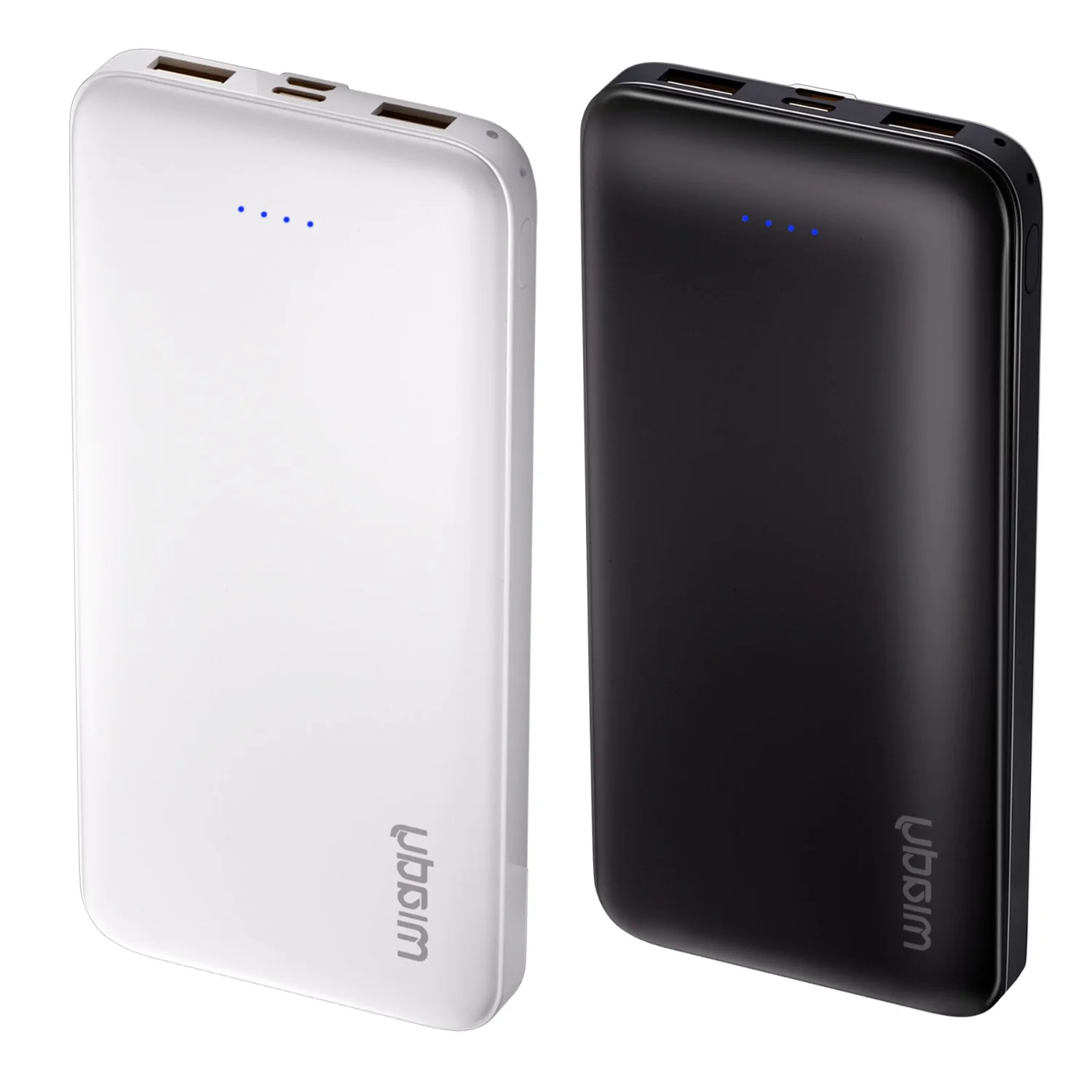
Several of our banks show their charge with a row of small lights, each standing for about a quarter of the battery. The display models print a number instead, the exact percentage left. That number helps when you are deciding whether a bank will see you through the afternoon or needs the wall first, and on a pair it tells you at a glance which of the two to grab on the way out.
A built-in plug or a cable
A mini with a built-in USB-C or Lightning plug goes straight into the phone and sits on its port, so there is no cable to forget. The trade-off is fit: the plug has to reach the port through your case, and a case thinner than about 4 mm works best. Our Lightning version is meant for iPhone 14 and earlier, and the USB-C version for phones with a USB-C port.
A bank with ports works with whatever cable your phone takes, today or after your next upgrade. Several of ours carry two cables built into the body, Lightning and USB-C, so the cable travels with the bank and you choose the end that fits.
Magnetic banks need a magnetic phone
A magnetic power bank holds onto the back of the phone and charges it without a wire. That only works on an iPhone with MagSafe or on a phone in a magnetic case. Without magnets in the phone or case, the bank slides off, though its USB-C port still charges the phone by cable. Wireless charging is slower than the wire: 5W on our 5,000mAh magnetic bank, and up to 15W on the 10,000mAh bank with the wall plug and stand, where an iPhone takes 7.5W. Some warmth during wireless charging is normal, and a non-original case can add to it.
Solar is a backup, not a charger
Our solar banks come in 10,000 and 20,000mAh. The panel tops the battery up in sunlight, but slowly, and how slowly depends on how strong the sun is and for how long. Charge yours from USB-C before you leave. Treat the panel as a way to claw back a little charge on a long trip or during an outage.
Flying with a power bank
Power banks go in your carry-on bag, never in checked bags. The FAA and TSA both set that rule, and the FAA adds that the terminals of spare batteries should be protected from short circuit. Its line is 100 watt-hours per battery. Every Miady power bank sits under it: the largest, at 20,000mAh, works out to about 74 Wh by the 3.7 volt sum.
Airlines can add rules of their own on top of these. Check with your airline before you pack, and keep the bank in the bag that stays with you at your seat.
In the range
Miady power banks to start with
Ready when you are
Power for the pocket and the pedestal
Power banks from 5,000 to 20,000mAh, cords and plugs from 15 to 50 amps, and batteries from 6 to 12 volts make up the Miady range.


Every power bank, cord, plug and battery of the Miady range in one place.