


RV power
30 Amp or 50 Amp: Plugging an RV Into the Pedestal
Read the pedestal before you unroll the cord
Pull into a campsite with electric hookups and you will find a post at the edge of the pad, usually with a hinged cover and a row of breakers inside. That pedestal is the campground's end of the connection, and its outlets tell you what it can feed. Most offer a 30 amp outlet, many add a 50 amp one, and a lot of them carry an ordinary household outlet as well.
Your camper's end of the connection is its shore power cord, and the plug on that cord decides which outlet you can use without help. Smaller travel trailers and many campers come with a 30 amp cord. Larger motorhomes and fifth wheels usually come with a 50 amp cord. The two plugs look different on purpose, so neither fits the wrong outlet by accident.
Before anything goes in, switch the pedestal breaker for the outlet you plan to use to off. Plug in, then switch it on. Reverse the order when you leave: breaker off first, then unplug. Arcing at the blades is what pits and blackens plug faces over time, and switching the load off before pulling the plug keeps the faces clean.
Six plugs turn up around an RV, and two of them look similar enough to cause trouble.
| Plug | Amps | Volts | Prongs | Where you meet it |
|---|---|---|---|---|
| TT-30 | 30 | 125 | 3 | 30 amp pedestal outlet, the cord of most smaller campers |
| NEMA 14-50 | 50 | 125/250 | 4 | 50 amp pedestal outlet, larger motorhomes and fifth wheels |
| NEMA L14-30 | 30 | 125/250 | 4, twist-lock | Generator panels |
| NEMA L5-30 | 30 | 125 | 3, twist-lock | Generator outlets and 30 amp power inlet boxes |
| NEMA 6-50 | 50 | 250 | 3 | Welders and shop outlets, never an RV pedestal |
| NEMA 5-15 | 15 | 125 | 3 | Household outlets, inside the camper |
TT-30: the 30 amp plug
The TT-30 plug has three prongs: two flat blades set at an angle to each other and a round ground pin below them. It runs at 125 volts and 30 amps, which works out to about 3,750 watts at the most. That is enough for a single air conditioner and a few smaller loads, provided you do not run the microwave, the water heater and the air conditioner all at once.
At the pedestal, the matching TT-30R outlet has the same angled slots and sits in its own space, usually next to its own 30 amp breaker. The angle of the blades is the quickest way to tell it apart from a household outlet, whose blades stand parallel and whose cord carries far less current. If a TT-30 plug does not slide in, you are looking at the wrong outlet.
A 30 amp shore cord carries three conductors of 10 gauge wire. When the plug on the end cracks, loosens or shows burn marks, the cord itself is often fine, and a replacement head brings it back into service. Our 30 amp replacement male plug is made for 10 gauge, three-conductor cords of this kind. Match the configuration on the new plug to the old one, and if you have any doubt about the wiring, hand the job to a licensed electrician. A plug that runs warm at the pedestal needs replacing, not another season of use.
NEMA 14-50: the 50 amp plug
The 14-50 plug is larger and has four prongs: two straight blades for the two hot legs, a third blade for neutral and a round ground pin. It carries 50 amps at 125/250 volts, and because it delivers two 125 volt legs of 50 amps each, the total comes to about 12,500 watts. That is more than three times the TT-30, and it is why big rigs can run two air conditioners and a full kitchen on one cord.


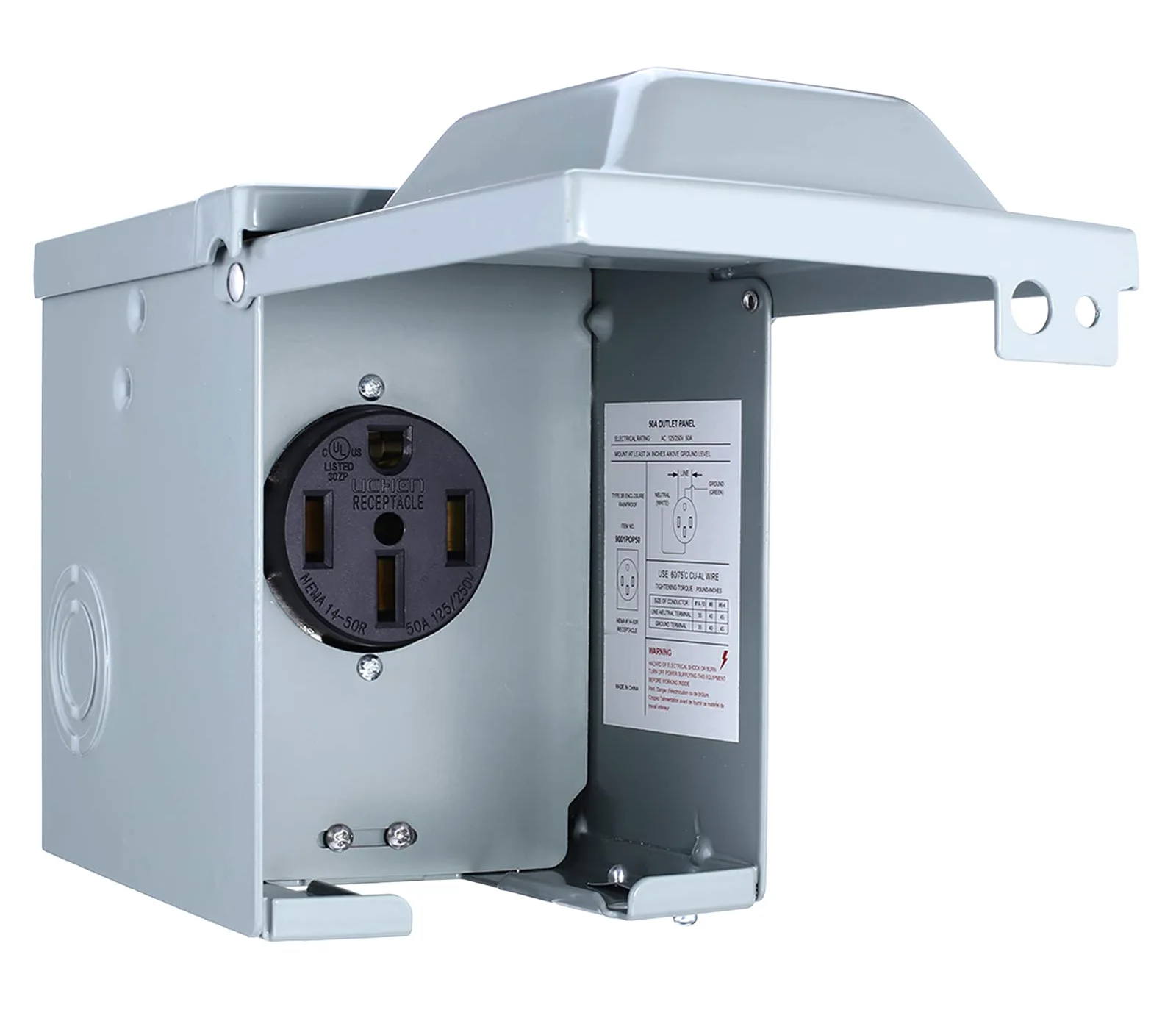
At the pedestal, the 14-50R outlet usually sits next to its own 50 amp breaker, often a two-pole breaker joined by a single handle. The same configuration turns up at home behind ranges, dryers and electric car chargers, and it is a common choice for an RV outlet in a driveway. Our 14-50R outlet box, like our TT-30R box, comes in a rainproof enclosure with a lockable door. A licensed electrician installs either one.
Our Miady RV plugs and adapters include a 50 amp replacement male plug and a 50 amp female plug for the far end of an extension cord, along with a NEMA 14-50P replacement plug. Each of them answers the same need: a cord worth keeping with a damaged end. Match the configuration, check that the cord gauge sits within the range the plug accepts, and leave anything you are unsure of to a professional.
The dogbone: a 30 amp camper on a 50 amp outlet
Sometimes the 30 amp outlet at a site is dead, worn, or missing altogether, while the 50 amp outlet works. A dogbone adapter bridges the gap. Ours is 18 inches of 10 gauge cord with a 14-50P plug on one end and a TT-30R outlet on the other, so a camper with a TT-30 cord can plug into the 50 amp outlet.
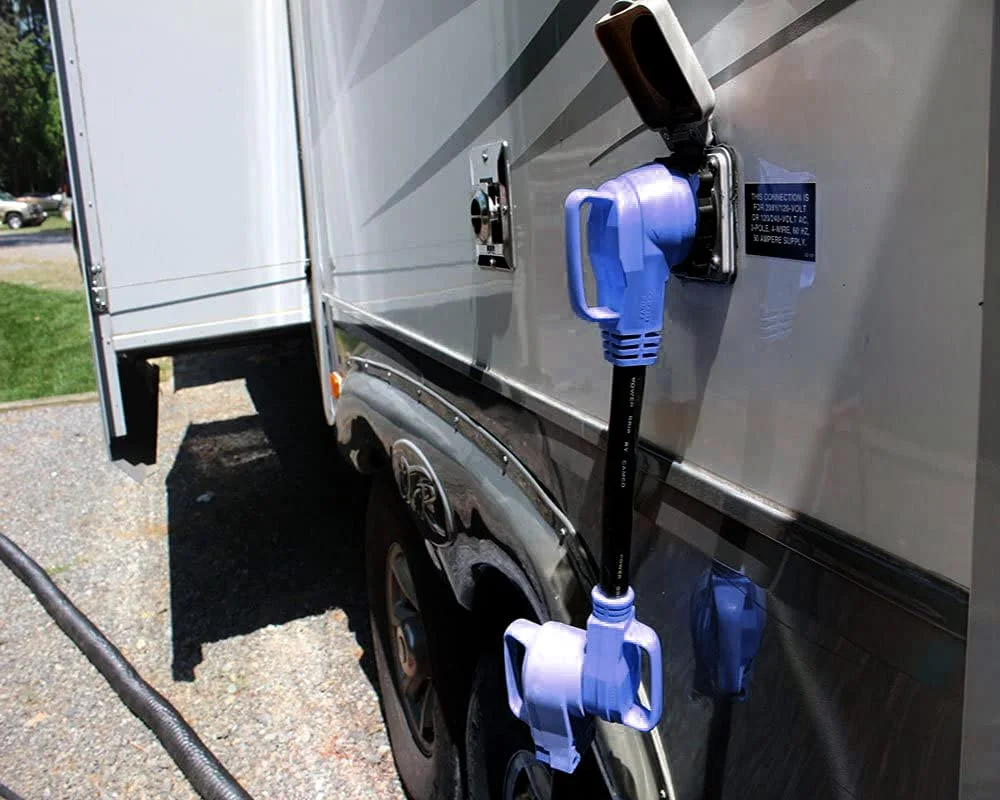
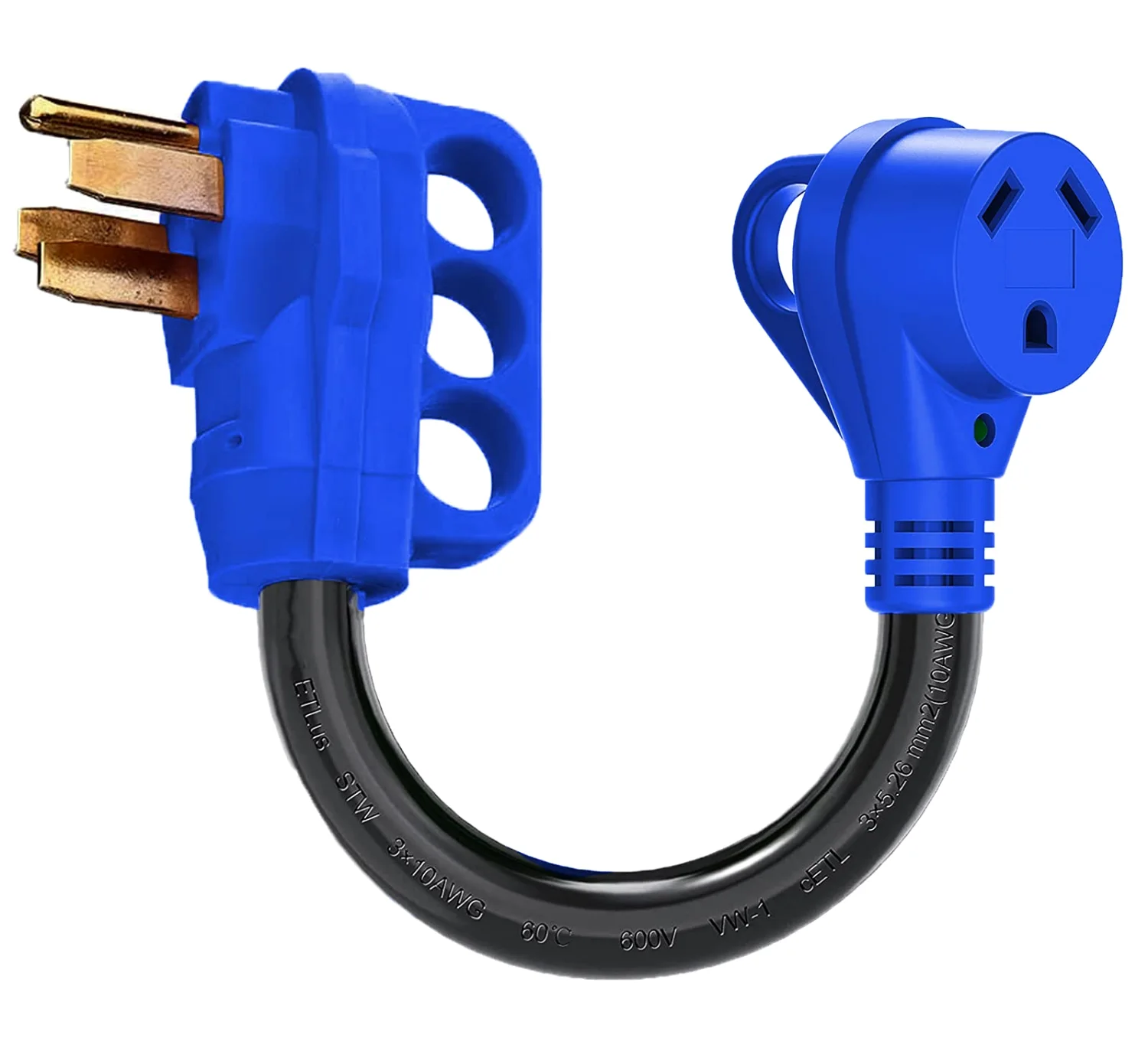
What the adapter does not do is raise your camper's capacity. Its outlet end is a TT-30R, a 30 amp outlet, and the adapter is rated at 125 volts and 3,750 watts. Your camper's cord, breaker panel and wiring are built for 30 amps too. The 50 amp outlet behind the adapter can supply more, but the camper still runs on a 30 amp budget, so the same rule applies: one big load at a time.
Length matters more than it seems. An 18 inch dogbone stays at the pedestal and hangs straight down, without long loops of cord on the ground. The same short adapter lets you plug your camper into a 14-50 outlet at home to cool the fridge before a trip, without dragging out a long cord. Ours has molded handles that give your fingers something to grip when you pull it out of a tight pedestal outlet.
Going the other way: a 50 amp rig on a 30 amp outlet
The reverse case comes up at older campgrounds, at friends' driveways and at sites where every 50 amp outlet is taken. A 50 amp motorhome can plug into a TT-30 outlet, but it needs a different adapter: one with a TT-30 plug and a 14-50 outlet. That adapter is not the dogbone above, and our shelf does not carry it.
Expect less from it than from your usual hookup. The TT-30 outlet supplies a single 125 volt leg of 30 amps, so the whole rig shares about 3,750 watts instead of 12,500. In practice that usually means one air conditioner instead of two, and turning off the water heater while the microwave runs. The rig's 50 amp panel works on the smaller supply, but the pedestal breaker trips the moment the rig asks for more than 30 amps.
When the breaker trips, resist the urge to switch it on again right away. Turn off one or two big loads inside the rig first, then reset it. If it trips with almost nothing running, stop and look for damage on the cord, the adapter and the pedestal outlet. Scorch marks, melted plastic or a smell of hot insulation point to a connection that needs replacing, and an adapter does not fix that.
Generators: L14-30 plugs, cords and inlet boxes
Off the grid, a portable generator takes the pedestal's place. Many generators carry a NEMA L14-30 twist-lock outlet on their panel: four prongs, 30 amps, 125/250 volts. You push the plug in and twist it, and it locks, so a running generator cannot shake it loose. Our Miady generator plugs include an L14-30P plug and an L14-30R connector, made for 10 gauge cord and generators up to about 7,500 watts with a 30 amp outlet. With them, you can rebuild a generator cord when an end breaks, matching each end's configuration to the original.
Running a generator to a house goes through a power inlet box mounted on an outside wall. Our 30 amp inlet box takes an L5-30 generator cord at 125 volts, and our 50 amp inlet box takes a 50 amp SS2-50 cord at 125/250 volts. When the cord is live, a green light on the flip-top cover comes on. A licensed electrician installs the inlet box and connects it to a transfer switch or an interlock, which keeps the house from drawing on the utility line and the generator at the same time.
Never backfeed a house by plugging a generator into a household outlet with a cord that has a plug on both ends. That cord leaves exposed, live prongs in your hand, and it can push power back into the utility lines, where line workers expect them to be dead. The inlet box and the transfer switch exist so that nobody has to take that risk.
Cords that match the load
Every cord between the power source and your rig has to be rated for the current it will carry. A 30 amp shore cord is 10 gauge with three conductors, and a 50 amp cord has four conductors. Household extension cords are built for far less. Running a camper through one makes the cord warm, then hot, and the plugs at each end take the worst of it.
Do not daisy-chain extension cords. Two or three cords plugged end to end add connections, and every connection is a place where heat builds up and water gets in. If you need more reach, use a single RV extension cord with the same rating as your shore cord, and keep its joints off wet ground. Our short 8-inch outlet savers are 16 gauge household cords and have no place in a shore power run.
A few habits keep the whole chain in good order:
- Unroll the cord fully before you load it, because a coiled cord holds heat.
- Look at both plug faces each time you connect, and replace any end that is cracked, loose or discolored.
- Keep the pedestal breaker off while you plug in and unplug.
- Store cords dry and coiled loosely, away from sharp edges in the storage bay.
When something looks wrong at the pedestal, the RV and generator plug guide lays out which plug, adapter or box fits which outlet, so you can find the right part before the next trip.

